Laboratory Notebook Graph Paper – KDP: A Practical Tool for Consistent, Professional Documentation
If you have ever tried to produce a laboratory notebook for print, you quickly discover that the difference between a usable product and a frustrating one often comes down to the interior. Graph paper that looks crisp on screen might print blurry. Margins that seem fine in preview can cause content to disappear into the binding. Page counts that sound reasonable may not align with what buyers actually need. Laboratory Notebook Graph Paper – KDP is designed specifically to address these real-world concerns. It is an interior file set built for Amazon’s Kindle Direct Publishing platform, intended for anyone who wants to upload a professional-grade lab notebook without starting from scratch or wrestling with formatting errors.
This article offers a practical evaluation of what this interior product provides, who it serves best, and where it fits into a broader workflow. The focus is on usability, consistency, and long-term value rather than hype or surface-level features.
What Makes This Interior Worth Discussing
A laboratory notebook is more than just paper with lines. It is a tool for recording experiments, observations, calculations, and data in a way that can be referenced later, sometimes in legal or academic contexts. The grid itself must be precise enough to sketch diagrams, plot data points, or write equations without distortion. At the same time, the overall layout must support everyday use: adequate margins, space for notes, and a clean appearance that does not distract from content.
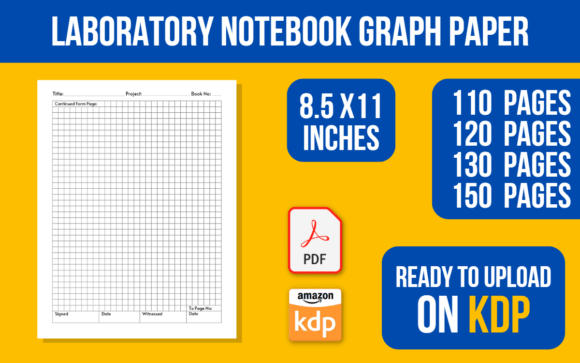
Laboratory Notebook Graph Paper – KDP addresses these needs with a straightforward approach. The dimensions are the standard US letter size of 8.5″ by 11″, which fits easily into shelves, bags, and binders. The interior is offered in multiple page counts – 110, 120, 130, and 150 pages – giving you flexibility depending on whether you are creating a slim introductory journal or a more substantial notebook for extended use.
One notable detail is the option to include or exclude a “Belongs to” page. That may seem minor, but it matters for branding and personalization. A notebook that includes a simple ownership page feels more polished and ready to gift or sell. Without it, the interior is slightly more flexible for those who want to customize their own front matter.
Key Specifications That Matter for Real-World Use
When evaluating any print-ready PDF, specifications are not just technical details – they directly affect the final product. Here is what this interior offers and why each point matters.
Bleed Configuration
The files include bleed. In print publishing, bleed refers to the extra area beyond the trim line that ensures content extends to the edge of the page after cutting. Without bleed, a thin white border can appear along the edges. For a laboratory notebook, where the grid often needs to run close to the edge for maximum usable space, proper bleed is essential. This interior accounts for that, so the final printed notebook looks intentional and polished.
High Resolution and Print Quality
The PDFs are built at 300 DPI (dots per inch). This is the standard for professional print work. At this resolution, the graph lines remain sharp and consistent, even when examined closely. Lower-resolution interiors – sometimes found in cheaper or rushed uploads – can result in fuzzy lines or uneven spacing. For a laboratory notebook, where precision is part of the purpose, 300 DPI is not just a nice-to-have; it is a baseline requirement.
KDP Testing and Error-Free Assurance
The product description states that these files are KDP tested and error-free. That means they have been checked against Amazon’s specific upload requirements, which can be finicky. Common problems like missing fonts, improper color profiles, or incorrect trim sizes have been addressed before you ever import the file. This saves a significant amount of time, especially if you are not deeply familiar with KDP’s technical guidelines.
The Value of High-Resolution, Print-Ready Design
It is easy to underestimate how much difference high-resolution design makes until you hold two printed notebooks side by side. One has crisp, even lines that guide the eye naturally. The other looks slightly off – lines may be too thick, too light, or inconsistent from page to page.
Laboratory Notebook Graph Paper – KDP uses a unique design approach. The term “unique” here is not about flashy graphics or decorative elements. In a laboratory notebook, uniqueness should mean thoughtful layout that balances structure with flexibility. The grid itself is consistent, with appropriate spacing for handwritten entries and diagrams. The margins leave room for binding without cutting off content, which is a frequent issue in notebooks that are designed without considering the physical limitations of paperback binding.
The inclusion of bleed means that if you want the grid to run edge-to-edge after trimming, it will. If you prefer to keep a clean white border, the file still allows for that because the grid is positioned knowing exactly where the trim line falls.
Who Benefits Most From This Type of Notebook Interior
Because the interior is designed for KDP, the primary audience is people who intend to publish and sell laboratory notebooks through Amazon. That includes:
- Small publishers and indie authors looking to expand their product line into educational or professional stationery.
- Freelancers and creators who want to offer custom-branded notebooks without learning advanced layout software or spending hours on formatting.
- Educators and researchers who may want to produce a class-specific or lab-specific notebook and distribute it through print-on-demand rather than bulk ordering from a commercial printer.
- Entrepreneurs and small business owners exploring low-risk ways to create physical products that complement digital offerings, such as courses, workshops, or consulting services.
The real-world application is straightforward: you download the files, add your cover, set your metadata, and upload. The interior is ready to go. This removes a significant barrier for people who have the desire to publish a notebook but lack the technical skills or time to design one from scratch.
Practical Observations on Usability and Workflow
From a workflow perspective, having a tested interior file is like starting at mile ten of a marathon instead of mile zero. You still have work to do – cover design, pricing, product description, keywords – but the most technically demanding part is already handled.
One aspect worth highlighting is the page count options. A 110-page notebook is relatively slim. It may appeal to buyers who want a focused journal for a single experiment or short-term project. A 150-page notebook, on the other hand, offers room for more extensive documentation. Having four options means you can test different price points and see which resonates with your audience without committing to entirely different designs.
The “Belongs to” page option is another small but practical feature. If you are targeting individual buyers who will use the notebook for personal research or study, having a dedicated ownership page adds a touch of professionalism. If you are creating a generic notebook for broad sale, omitting it keeps the interior neutral and compatible with a wider range of uses.
Because the files are PDFs with 300 DPI resolution, they can also be used for purposes beyond KDP. For example, you could import the PDF into a program like Adobe InDesign or Canva to add your own branding, page numbers, or section dividers before uploading. The high resolution ensures that any modifications remain print-ready.
Considerations and Possible Limitations
No product is perfect for every situation, and it is fair to consider where this interior might fall short for some users.
The file set is specifically designed for KDP’s US letter size (8.5″ x 11″). If you need an A4 size or a different trim, this interior will not work without scaling, and scaling can affect bleed and margin placement. Similarly, the page count options are limited to the four mentioned. If you want exactly 96 pages or 200 pages, you may need to duplicate pages or find a different solution.
The design, while tested and clean, is relatively standard. That is a strength for most buyers, but if you want something highly distinctive – colored grids, decorative headers, or specialty paper textures – this may not be the right fit. It is a functional interior, not a decorative one.
Also worth noting is that “unique design” in this context refers to the layout and formatting choices, not an entirely original grid pattern. The graph paper follows conventional spacing that scientists, engineers, and students are accustomed to. If you are looking for something unconventional, such as isometric grids or semi-log plots, this interior will not provide that.
Long-Term Value and Reliability
For someone publishing on KDP, the long-term value of a tested interior file is significant. Every time you upload a book that gets rejected for a formatting error, you lose time and momentum. When a notebook sells and prints, you want to be confident that the physical copy matches what the buyer expects. A well-built interior reduces returns and negative reviews related to print quality.
Because these files are high-resolution and include bleed, they are likely to print well not just on KDP but on other print-on-demand platforms if the trim size matches. That gives you a degree of portability if you ever want to expand to other channels.
Laboratory Notebook Graph Paper – KDP also holds up well for repeated use. The design does not rely on trendy elements that will look dated in a year. Graph paper is a timeless format, and a clean, straightforward layout will continue to serve buyers regardless of shifts in design trends.
Final Thoughts on Choosing the Right Laboratory Notebook Interior
If you are in the process of creating a laboratory notebook for KDP, the interior is the foundation. A strong foundation means consistent print quality, proper margins, reliable bleed, and a layout that works for the intended audience. Laboratory Notebook Graph Paper – KDP delivers on these fundamentals without unnecessary complexity. It is a practical, professional option that fits a range of page counts and includes the features that matter most: high resolution, KDP compatibility, and a choice of front matter.
For indie publishers, educators, freelancers, and small business owners, this interior removes the most tedious part of the publishing process. You still need to create a compelling cover, write a clear product description, and understand your target audience. But you can do all of that with confidence, knowing that the interior itself will not cause printing issues or disappoint buyers.
The best tool is often the one that quietly works and stays out of the way. This interior is that kind of tool – useful, reliable, and designed with the end user in mind.