Ultimate Money Savings Challenges
There is a quiet gap between wanting to save money and actually watching the numbers grow. Most people start with good intentions. They open a spreadsheet, draw a few lines in a notebook, or download a generic black-and-white chart. Within a few weeks, the sheet is buried under paperwork or the notebook page feels too disconnected from the rest of their life to matter. The habit fades. What gets lost in that process is the role that design plays in forming a routine. If the tool you use feels haphazard, the action feels optional. The Ultimate Money Savings Challenges kit closes that gap. It takes the mechanics of saving and wraps them in a visual system that feels intentional, polished, and genuinely motivating. This isn't just a collection of trackers. It is a design asset built for creators, entrepreneurs, and anyone who treats their financial goals seriously.
A Visual System Built for Consistency and Motivation
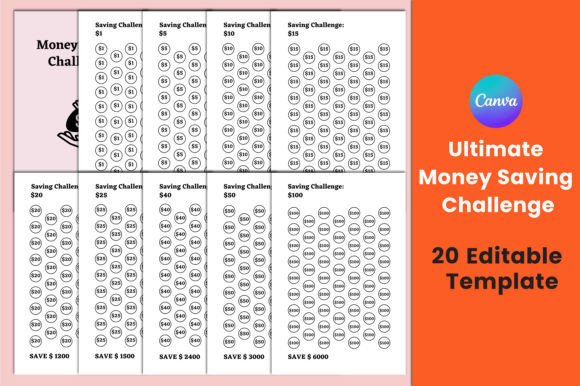
The first thing you notice about these templates is the cohesion. Across all 20 pages, from the single dollar challenge up to the $500 tracker, the visual language remains consistent. The grids are clean. The typography leans on modern sans serif fonts that keep the large numbers highly readable, whether you are looking at a 52-week overview or a 30-day sprint. The structure avoids clutter. Every element, from the progress bars to the checkboxes, has a purpose.
This is not a haphazard worksheet. The design personality blends a friendly, approachable tone with a professional, editorial structure. It feels aspirational without being naive. The modern typography choices give the trackers the same polish you would expect from a premium font kit or a high-end planner. If you look closely at the layout of the 100 Envelope challenge or the Emergency savings tracker, you will notice how the visual hierarchy directs your eye to the most important number first. The layout respects the reader. That respect translates into a tool you actually want to engage with every single day.
Where the Ultimate Money Savings Challenges Excels
Because the kit comes with PDF, JPG, and PNG files at 300 DPI, it works across nearly every medium a creator or small business owner might use. The real strength is how easily it adapts to different workflows.
For Digital Planners and Content Creators
If you use a tablet for planning, the PNG files drop seamlessly into apps like GoodNotes, Notability, or OneNote. The transparent backgrounds or clean white pages let you overlay your own stickers or digital notes. For content creators, sharing a high-quality savings tracker on social media builds immediate trust with your audience. You can screenshot the JPG files or upload the PDF as a lead magnet for your newsletter. The consistent design assets make your brand look organized and professional.
For Print and Personal Use
The 8.5 x 11 inch format is standard for binders and planners, and the no bleed design means you can print at home without worrying about edge cutting. The 300 DPI resolution ensures crisp lines and sharp text. If you are running a small business, pinning the Emergency savings challenge or the 20 Dollar tracker to your office wall creates a visible reminder of your cash flow goals. It turns an abstract number into a daily visual anchor.
For Customization and Branding
This is where the editable Canva link changes everything. You do not need to be a professional designer to adjust the colors or swap the typography. If your brand identity uses a specific shade of blue or a handwritten script for headlines, you can match that exactly. The ability to edit the templates means you can create a coordinated set of challenges for a whole year. Print them all at once, and you have a complete financial planning system that feels custom-made. For designers and crafters, this flexibility is the difference between a generic download and a true creative font and layout playground.
How Strong Design Affects Your Savings Behavior
Design is not just about looking good. It shapes how you interact with a tool. The Ultimate Money Savings Challenges kit uses layout and typography to make the act of tracking feel rewarding rather than tedious.
Readability and Visual Hierarchy
When you have a $500 goal, the number itself can feel overwhelming. A well-designed tracker breaks that number into manageable pieces. The 26 Week challenge or the 52 Week challenge uses clear, bold sans serif fonts for the totals and smaller, lighter text for the weekly increments. This visual hierarchy prevents the eye from getting lost. You see the big picture, but you also see the clear, simple step you need to take today. The modern typography removes friction. You do not stop to decipher a messy script or a cramped table. You just fill in the box and move on.
Brand Perception and Professionalism
How you treat your savings reflects your overall discipline. Using a high-quality, professionally designed tracker signals to your own brain that this task matters. It elevates the chore of saving to the level of a serious project. If you are a freelancer or a solopreneur, using a consistent brand identity across your financial tools and your client work reinforces a mindset of competence. The same goes for your audience. If you offer these trackers as a freebie, the high production value increases the perceived value of your entire brand.
The Role of Consistency in Habit Formation
Having 20 different templates that all feel like they belong to the same family reduces cognitive load. You do not have to re-learn a new layout every month. Whether you are switching from the 30 Day savings challenge to the 100 Envelope challenge, the visual grammar stays the same. This consistency is a core principle of strong editorial design. It creates a sense of familiarity that makes the tracking process feel automatic. You spend less time figuring out the tool and more time actually saving.
Practical Guidance for Choosing and Using Your Templates
With so many options inside one kit, the key is to match the challenge to your specific financial goal. The variety is a strength, but only if you use it intentionally.
Match the Challenge to the Goal
Ask yourself what you are saving for. A short-term burst of motivation works best with the 30 Day challenge or the Emergency savings challenge. These are quick wins that build momentum. If you are planning for a bigger purchase or an investment, the 52 Week challenge or the $500 tracker gives you the structure to sustain a long-term habit. The visual layout of each challenge is designed to support that specific pace. The longer challenges use wider grids and softer progress markers to keep you engaged over time.
Experiment with Font Pairings and Colors
This is where the editable Canva link becomes your best tool. The default design is clean and effective, but you can make it truly yours. If you prefer a warmer tone, try swapping the sans serif fonts for a handwritten script in the headers. If you want a more authoritative look, a serif font for the titles paired with a clean body text creates a classic, trustworthy feel. Test how the colors look on your screen and printed on your home printer. The ability to customize means you are not locked into a single style. You can adapt the kit as your taste or your brand evolves.
Review Your Formats and Licensing
Before you start editing, think about how you plan to use the files. The PDF is ideal for printing exactly as designed. The PNG files give you flexibility for digital use, especially if you want to layer them into social media graphics or digital planners. The JPG format works well for quick uploads or sharing progress in an online community. If you are a small business owner or a content creator, the commercial licensing allows you to use these templates as client resources or lead magnets. Treating them as premium design assets means you can confidently build them into your paid offerings or use them to enhance your professional workflow.
Batch Print and Plan Ahead
One practical habit that saves time is printing an entire set of challenges at once. Fill out the Canva link first, match the colors to your planner system, and export the PDF. Print the ones you know you will use over the next quarter. Having the 26 Week challenge, a 30 Day challenge, and an Emergency tracker all ready to go means you can switch between them without breaking your routine. The consistent page size makes it easy to store them in a single binder or folder.
A Final Observation on Intentional Design and Money
The Ultimate Money Savings Challenges kit works because it treats the act of saving with respect. It assumes that the person using it values clarity, consistency, and a bit of visual beauty. Whether you are a designer fine-tuning a brand identity, a blogger creating resources for your audience, or a freelancer mapping out your next six months of income, the structure and quality of these templates remove the friction from financial tracking. It turns a spreadsheet into a ritual and a number on a page into a visible representation of your progress. That shift in perspective, supported by strong design, is what makes the difference between a plan that sits in a drawer and a goal you actually reach.